

When you look at expert rankings for wide receivers, some of the biggest discrepancies are on those players who are changing situation this year. That’s understandable, no-one really knows what the impact will be of those new situations and there are a lot of different variables that we’re all trying to decipher. I decided to look at just one of those variables, the Quarterback, to understand what impact they might have on some of the top receivers.
DeAndre Hopkins
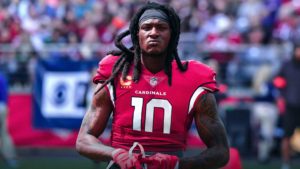
Let’s start here. Hopkins was the subject of one of the most bizarre trades in recent history and finds himself in an offense with a 2nd year head coach and a 2nd year Quarterback. He’s also leaving one of the most exciting Quarterbacks in the league in Deshaun Watson.
The good news is, he’s going to another exciting young Quarterback and Hopkins has a history of performing regardless of who the Quarterback is.
I’m largely using playerprofiler.com here for my numbers. For anyone who doesn’t already know, this is an incredible resource for really digging in to some advance stats on players and seeing how they stack up with different variables removed. One such stat is True Completion Percentage which takes away dropped passes and unpressured throwaways. Here’s how the two QBs look in that regard.
- Watson 72.1
- Murray 70.6
Then we have accuracy rating, which does exactly what it says on the tin.
- Watson 7.2
- Murray 7.1
Put those together and you see that Murray was only slightly less accurate than Watson last year, but he was in his rookie year. It’s fair to assume that Murray improves his accuracy in year two and then we’re not really looking at a step-down for Hopkins.
In fact, when you start comparing stats across the board, the only significant difference between the two is completion rate under pressure. Again, something I’d expect to improve for a sophomore QB and something I would expect Hopkins to actually help with.
Hopkins’ overall numbers may suffer from scheme in Arizona (with the targets being spread around much more than they were in Houston) but the Quarterback play shouldn’t cause him too many problems.

QB CHANGE IMPACT 

Stefon Diggs
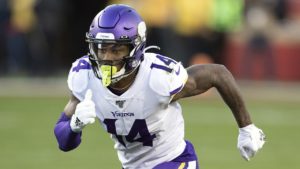
Another receiver changing team but this time it’s one who is going to a significantly different Quarterback.
True Completion Percentage
- Cousins 76.0
- Allen 64.7
Accuracy Rating
- Cousins 7.4
- Allen 6.5
Completion Rate Under Pressure

- Cousins 40.6
- Allen 17.1
That’s a downgrade across the board but look at that completion rate under pressure for Josh Allen – 17.1! If Allen is under pressure, he’s not getting Diggs that ball.
Sure, Diggs could help improve Allen’s numbers and he’s still young but that is a huge drop in quality from the guy delivering him the ball.
Next Gen Stats also has Allen with a negative 3.7-percent differential between expected completion rate and actual completion rate whereas Cousins had a 5.5-percent positive differential. If we take this for what it is, then Allen was also let down by his pass-catchers. The addition of Diggs will help that so maybe it’s not quite as bad as it looks, but it’s fair to say this could be a downgrade for Diggs.
QB CHANGE IMPACT 

DJ Moore
Ok, this one is easy. In 2019, DJ Moore was being thrown to in the most part by Kyle Allen. Shall we move on?
Our next receiver is….
Alright, sorry, that was unfair. Kyle Allen actually wasn’t THAT bad but his 67.5-percent True Completion rate was 26th in the league and his 34 interceptable passes was 3rd. And of the top 50 WR from 2019, DJ Moore was 37th in catchable passes. Contrast that with his True Catch Rate (reception percentage based solely on catchable targets) which was 9th from this group.
What does that mean? It means when the Quarterback isn’t missing him, he’s going to catch it. It means that if you re-calculated 2019 WR stats using their True Catch Rate, you’d get the following receiving yards leaders:
- Michael Thomas
- Chris Godwin
- Julio Jones
- Cooper Kupp
- DJ Moore
And it means that an improvement in QB play in 2020 should lead to a significant uptick in performance.
Teddy Bridgewater, come on down. We don’t have much of a recent sample size to judge whether Teddy is going to make a significant difference but his 76.4-percent True Completion rate from the games he did play last year was 4th in the league and his Next Gen expected completion rate was almost 4-percent higher than Allen. Again, small sample size, but it should give us some comfort that he’ll be an upgrade from Kyle Allen. We knew that already didn’t we?!
QB CHANGE IMPACT 
Mike Evans and Chris Godwin
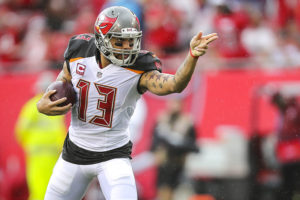
I’m putting these two together so we can focus on the QB change that clearly affects them both. Just in case you’ve been living under a rock, there’s a new guy in town and he’s somewhat different to the old one (provided he takes those rings off before he throws the ball – imagine if he left them on to play, he’d probably throw more interceptions than Winston!).
Now, some of these stats may surprise you, they surprised me. However, we know that Brady is not the same guy he’s always been so maybe I shouldn’t have been surprised. Here are the numbers:
True Completion Percentage
- Winston 65.2
- Brady 66.0
Accuracy Rating
- Winston 6.7
- Brady 6.9
Completion Rate Under Pressure
- Winston 37.2
- Brady 28.4
Not a great start for those expecting Brady to be an upgrade.
There are some differences though. Completion percentage might be on par but Next Gen Stats expected completion rate has Brady higher. However, and this is a big one, when you adjust the expected completion rate based on the depth of target, they’re back on par. In other words, Winston’s completion rate was only lower because he threw it deeper.
So QB accuracy isn’t really an issue. And with a True Catch Percentage of 91.5, Chris Godwin has the 3rd best rate amongst our top 50 WR so with a similarly accurate Quarterback, we can expect his production to continue.
What about throw depth? For the last two years, Brady’s intended air yards per attempt has been around 3 yards less than Winston. But in 2017, it was only 1.5 yards less. It could be Brady’s age bringing him down or it could be that Brady can only throw to the weapons he has and trusts. For the last two years, that’s been Edelman and Gronk who love those short to immediate targets. In 2017 he had Brandin Cooks. Coincidence that his target depth was higher? I doubt it. Do you think Brady is going to trust Mike Evans downfield? Of course he is.
The bad news could be separation. Mike Evans doesn’t get much separation (95th in the league in target separation per playerprofiler) and Brady is used to Julian Edelman who ranks 29th. In fact, with the 6th best receiver target separation in the league last year, Brady finished 17th and 16th in interceptable and danger plays. Contrast that with Winston who hit number one in both of those categories, while the Bucs receivers ranked only 13th in target separation. Evans has benefited from the ‘no risk it no biscuit’ danger man who will air it out and let Evans do his thing. The fear would be that Brady’s penchant for throwing to open guys stops him throwing it up for Evans when he can’t get separation. Here’s hoping Arians gives him a push in the right direction.
QB CHANGE IMPACT 
Honorable Mention
There are plenty of other receivers who are changing QB this year and plenty of other stats to dig in to but I don’t want you losing focus and missing the good stuff.
Before we close, an honourable mention for the Chargers receivers who go from Philip Rivers to Tyrod Taylor, who runs more, throws less, throws shorter and throws less accurately. Not good news for those guys, particularly Mike Williams who gets the risky downfield throws.
Oh, and JuJu is getting Big Ben back – not technically a ‘new’ QB but remember what JuJu did the last time his QB wasn’t Mason Rudolph or Duck Hodges?!