

Evan Engram 2020 Fantasy Football Preview
When it comes to drafting a Tight End in redraft leagues, there are generally two camps. Camp one is to draft Kelce or Kittle early. Camp two is to wait until the later rounds and draft someone who we’re convinced is going to have a breakout year.
I can absolutely buy in to both of those strategies but I’m going to try and convince you that there’s a third option. An option where you get a much greater chance of high-level production than the late round breakouts but at a much cheaper cost than Kelce or Kittle (or even Andrews or Ertz for that matter).

May I introduce Evan Engram, a 2020 fantasy bargain. I know you’re going to say ‘injury risk’ and I have some options for that, we’ll get there.
Camp One – Kelce or Kittle
The benefits of drafting one of these TEs is clear – elite, guaranteed production. The downside is it’s a high draft cost. You’ll need to spend a second round pick to get one of these two and that means missing out on an elite wide receiver or the last of the trusted running backs. You get a positional advantage but it’s costly, which is why a lot of us won’t do it.
Camp Two – Late Round Breakouts
It seems that this year more than ever there are a whole bunch of late-round TEs that are being predicted to breakout. And that gives a lot of confidence to wait and go with this strategy. But let’s look at some numbers.
- 25-percent. That’s the hit-rate of late-round TEs that finished top-12 (on a points-per-game basis) in 2019. Yes we got Mark Andrews, Darren Waller and Austin Hooper from this group but Vance McDonald and David Njoku were drafted over all of them (per fantasy football calculator).
- Fifteen. That’s my quick check on how many of the late-round TEs people are talking up this year, and that’s not all of them. Hurst, Higbee, Henry, Cook, Fant, Hooper, Hockensen, Gesicki, Jonnu Smith, Goedert, Jarwin, Ebron, Doyle, Irv Smith, Thomas. Remember, we’ve already got Kelce, Kittle, Andrews, Ertz, Waller, Gronkowski, and Engram above them (this is based on current ADP on fantasy football calculator so might not be exactly as you see it in your drafts). This gives us our next number:
Related | Finding Late Round Tight End Values In 2020 Fantasy Drafts
- 33-percent. There are seven guys above our late-round guys. If you’re expecting to draft a top-12 Tight End, there are five spots left and fifteen to choose from. That’s a 33-percent chance of getting it right at best (assuming there isn’t someone outside of that list that gets there). I’ll take you back to the first number and remind you that last season had a 25-percent hit-rate. So with all these late-round guys available, do you really think you can pick one from the 33-percent? You might. But chances are you won’t. May the odds be in your favour.
At this point you’re probably committing to streaming the position and you could get lucky by picking one of the 33-percent up off waivers if you don’t select the right one in your drafts but again, chances are you won’t when your league-mates are battling to do the same.
Upside
We draft for upside, don’t we? Do we?!
How often do you hear that you get your stable performers in the early rounds, the ones who you know you can trust in your lineups every week, and then draft for upside later on. Get your stud RBs, get your high-volume WRs, then shoot for the moon. That works because you have those stable position players ahead of them.
With TE, you generally only have one of them in your lineup each week. You don’t have the stable performer that enables you to shoot for the moon with others. You could shoot anyway, but you’re risking dud performances from that position on a weekly basis and, unless you get lucky you’re going to be annoyed about it every single week.
The pure upside approach is akin to the zero RB strategy. Don’t worry about the solid performers at the position, just go for upside. I’m not getting in to a zero RB debate right now but when it works, it works because you take multiple upside RBs and hope that some of them hit. Apply that here to the TEs and it would only work if you play the odds and draft multiple TEs. Park that thought.
The Engram Alternative
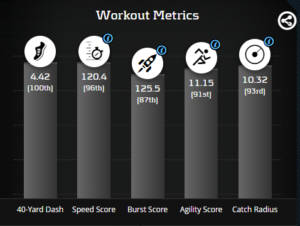
Option three is the middle ground. It’s drafting one of the mid-round TEs that aren’t at the same level as Kelce or Kittle but also aren’t going to cost you the same level of draft capital. And the TE at the end of that tier, the one that will cost you the least (a 7th round pick in 2020 fantasy drafts) is Evan Engram. By the 7th round you could have your other skill position players locked up and you’re getting down in to the big tiers of receivers and running backs that you can wait multiple rounds to draft. So the missed opportunity cost on those players is not significant.

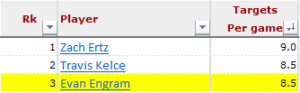
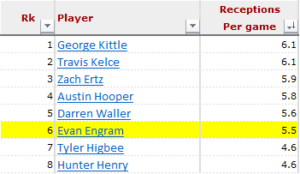
And the advantage of getting Engram is guaranteed production. In his first three years in the league, he has finished 4th, 7th and 7th in points-per-game. Only Kelce, Kittle and Ertz have finished in the top-10 for all three of those years.
In 2017 (Engram’s rookie year), he produced over 9 PPR points (that’s top 12) in 10 out of 15 games. He produced over 11.5 PPR points (top 5) in 7 out of 15.
In 2018, over 9.5 PPR points (top 12) in 6 out of 11 games and over 12.1 (top 5) in 5 out of 11.
In 2019, over 10.8 PPR points (top 12) in 5 out of 8 games and over 13.9 (top 5) in 3 out of 8.
When he plays, he puts up points. It’s simple, it’s predictable and it’s trustable.
The Injury Risk
Ladies and Gentleman, we have reached the elephant in the room. I’ve so far been trying to convince you why Engram is good and ignoring the fact that he gets injured every single year. That’s a problem, I get it. But I have a suggestion.
Kaden Smith.
When Engram has missed games, the alternative Giants TE has been good. In 2017, it was Rhett Ellison. He scored 11.3 PPR point in week 16 when Engram was out. In 2018, Ellison again got 5.9, 5.7, 11.7 and 8.2 PPR points – excellent in one game, very good in another, and serviceable in the other two.
In 2019, Kaden Smith was the guy. After Engram went down, Smith got a 16-percent target share with a 74-percent catch rate. In the games with Daniel Jones, that rose to 17-percent and 76-percent. That’s the 5th highest target share for a rookie TE since 2010 and the 2nd highest catch rate from rookie TEs with double-digit target share.
So this tells us two things. Firstly, even without Engram, the Giants still target the lead TE. The volume is there. Secondly, Kaden Smith is pretty damn good and has already shown he can put up numbers if he’s called in to action.
The Strategy
Ok, so what do we do about it? The idea leads to a handcuff scenario. But the thought of drafting a TE handcuff seems ridiculous. I have three lines of thinking for you.
Thought bubble number one – you draft Engram in the 7th or 8th round and you run with it. When he’s fit, he’s going to produce and you’ve got yourself a positional advantage at a bargain price (his injury risk is already in his draft cost so whenever he isn’t injured, he’ll easily out-perform that cost). When he goes down, you run to the waiver wire and hopefully you pick up Smith before anyone else does.
See Where Evan Engram Lands In Our 2020 Fantasy Football Rankings!
Thought bubble number two – you draft Engram in the 7th or 8th round and then you take Kaden Smith with your very last pick. This is handcuffing, and I get it, you don’t handcuff Kelce so why would you handcuff Engram. Well the difference is the known injury risk. Top fantasy analysts say not to handcuff your own running back, go for the upside by drafting someone else’s. With the exception of Dalvin Cook, where they insure the early draft capital by picking up Mattison later on. This is that same approach, it’s a next-to-no cost insurance policy that gives you guaranteed production for a 7th/8th round pick plus a bench spot.
Thought bubble number three – if you do this, you’re using two spots on TEs. I’m hearing a lot of chatter about taking two of the late-round guys anyway, to increase the hit-rate and allow matchups to be played. In this scenario, I ask you what is the difference? Option number one, you take two late-round guys to give yourself an increased chance of getting a top four or five TE at the expense of two roster spots. Option number two, you take a TE who you know can produce top five TE numbers when they’re fit and using the same amount of roster spots to lock it up.
Conclusion
The way I see this, here are your TE options.
If you’re drafting one TE:
- Spend the early draft capital on Kelce or Kittle. Be comfortable with your TE spot and work hard to fill the gaps where you passed on a top WR or RB; or
- Wait until late and pick ‘your guy’ and take a big risk of getting one that hits top-12, commit to streaming the position and see if you can eventually land the right one before your league mates do; or
- Draft Evan Engram in the middle rounds and have a positional advantage with guaranteed 2020 fantasy production at a fraction of what guaranteed production usually costs. When he goes down injured, rush to get his backup
If you’re drafting two TEs:
- Wait until late and pick two ‘your guys’ and increase your chances of getting a top-12 guy, but still with a big unknown/big risk of getting there; or
- Draft Engram in the middle rounds, take Smith late and lock up that TE positional advantage with the same amount of roster spots but a lot less risk
Don’t forget, not everyone in your league is getting a late-round guy (probably only a handful will be picked up) so if one of them does breakout you can still go fight for them off waivers. But in the meantime, you have much more trustable production at a fraction of the cost of the only other TEs that have produced top-10 PPG numbers for the last three years.
This won’t be for everyone and it will depend on where he falls, but if you can get Engram at a value and lock up top-10 numbers then a simple, late-round insurance policy might just do the trick.