

Mark Andrews 2020 Fantasy Football Preview
Mark Andrews has been fascinating me all offseason.
He finished as the No.5 tight end, both on season-long numbers and points-per-game in 2019. If you drafted him, you likely did it late and the value you got was incredible out of the gates with 220 yards and two touchdowns on 16 catches in the first two weeks.

He was also one of only three players to get double digit touchdowns last year. There’s no doubt about it, if you had Andrews on your team in 2019 then you got fantastic production for an incredible value.
Move on to 2020, Hayden Hurst leaves 39 targets and plenty of snaps behind, and the common consensus appears to be that this gives Mark Andrews an increase in fantasy production.
But conventional wisdom also tells us that touchdowns regress and his number is likely to come down. And I can’t help shaking a theory about Andrews needing to do some more of the dirty work that Hurst was doing. Let’s pick it apart.
The Man
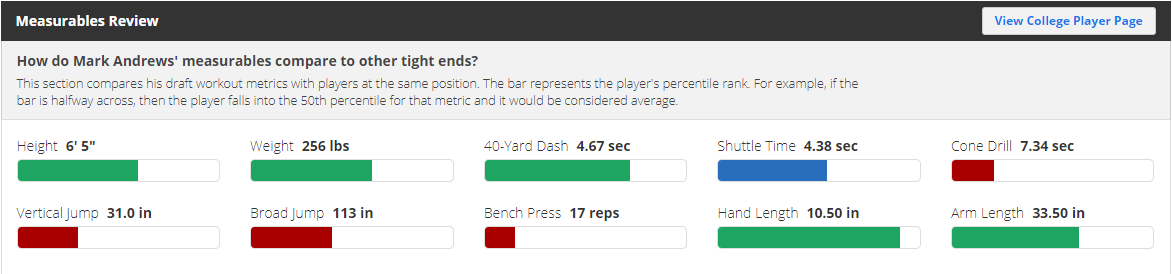
Andrews is big, fast and dominant, but he’s not exactly agile. The rest of his measurables don’t stack up well against other Tight Ends as you can see.
But Andrews was dominant in 2019 and the fact that the Ravens were happy to trade away Hurst shows how happy they are with him.

He was the main target in that team by a long way and grades as 2nd in yards per pass route (per playerprofiler). This led to him being the 5th most targeted tight end, getting the 5th most yards across the season and, as noted earlier, the most touchdowns.
How much did the touchdowns prop up his numbers? If we regress his touchdowns to six (puts him in a similar range to the rest of the top Tight Ends), his points-per-game finish would have still been top ten. Still great but much closer to the Hunter Henry, Jared Cook range than the Zach Ertz range where he’s currently being drafted.
The Myth
I laid this out at the start – Hayden Hurst has moved on and that means more snaps and targets for Andrews. At least that’s the myth.
Firstly, lets look what Hurst’s role was that he’s leaving behind. The good news is, he wasn’t blocking. Hurst ran routes 97-percent of the time he was on the field for a passing play. So Andrews doesn’t need to fill in blocking, they have Nick Boyle for that.
Secondly, lets look at how often Hurst was on the field.

- Total snap share 44-percent
- Passing plays 47-percent
- Rushing plays 42-percent
Related | Finding Late Round Tight End Values In 2020 Fantasy Drafts
Bearing in mind that Boyle was on the field for 74-percent of offensive snaps, that would suggest Andrews needs to fill the gap that Hurst leaves. However, if he did this then he’d be on the field 88-percent of the time. That’s a lot. Especially when you consider that Andrews’ snap share for the first two years of his NFL career has been 35-percent and 41-percent. That would be a huge jump for him to make and wouldn’t be in keeping with the approach that the Ravens have taken so far. They’ve had success from rotating their Tight Ends, why stop now?
So if Andrews is going to fill in some of those Tight End snaps that Hurst leaves behind, someone needs to give Andrews a break on the role he was playing. Here’s where my theory comes in to play.
In 2019, Andrews lined up in the slot 34.4-percent of the time, whereas Hurst lined up more often as a true Tight End. He still ran routes most of the time, but he was starting from a different spot on the field. The Ravens aren’t just going to leave that ‘Hurst spot’ open, so it’s reasonable to expect Andrews to slide in here more often. To do that, the Ravens would then need to fill in Andrews’ role in the slot.
What’s that? They drafted two slot receivers in the 2020 draft? Yes they did. Is this starting to make sense yet? Andrews drops in tight, and one of the capable slot receivers runs out of the slot. Seems pretty simple to me.
The Legend
You can see my theory is that Andrews is sliding in more in the Hurst position but I’m not suggesting he’ll be on the field any less than he was in 2019. He could be on the field more, like many are suggesting, but I don’t buy a significant jump. Let me remind you, Andrews was on the field for 35-percent and 41-percent of offensive snaps in his first two years. He’s not about to jump to 70-percent plus.
And if he needs to be on the field on more run plays (the Ravens had 2 or more Tight Ends on the field on 45-percent of rushing plays in 2019) then that takes away even more of that freshness.There’s also an underlying health question with Andrews and his diabetes. I don’t know if anyone really knows what, if any, impact that has but it should be something to consider at the back of your mind when thinking about how often he’ll be on the field.
The extension of my theory then is that, even though he’s on the field just as much, he’s going to line up less in the slot. I looked at what difference this makes to a Tight End’s targets.
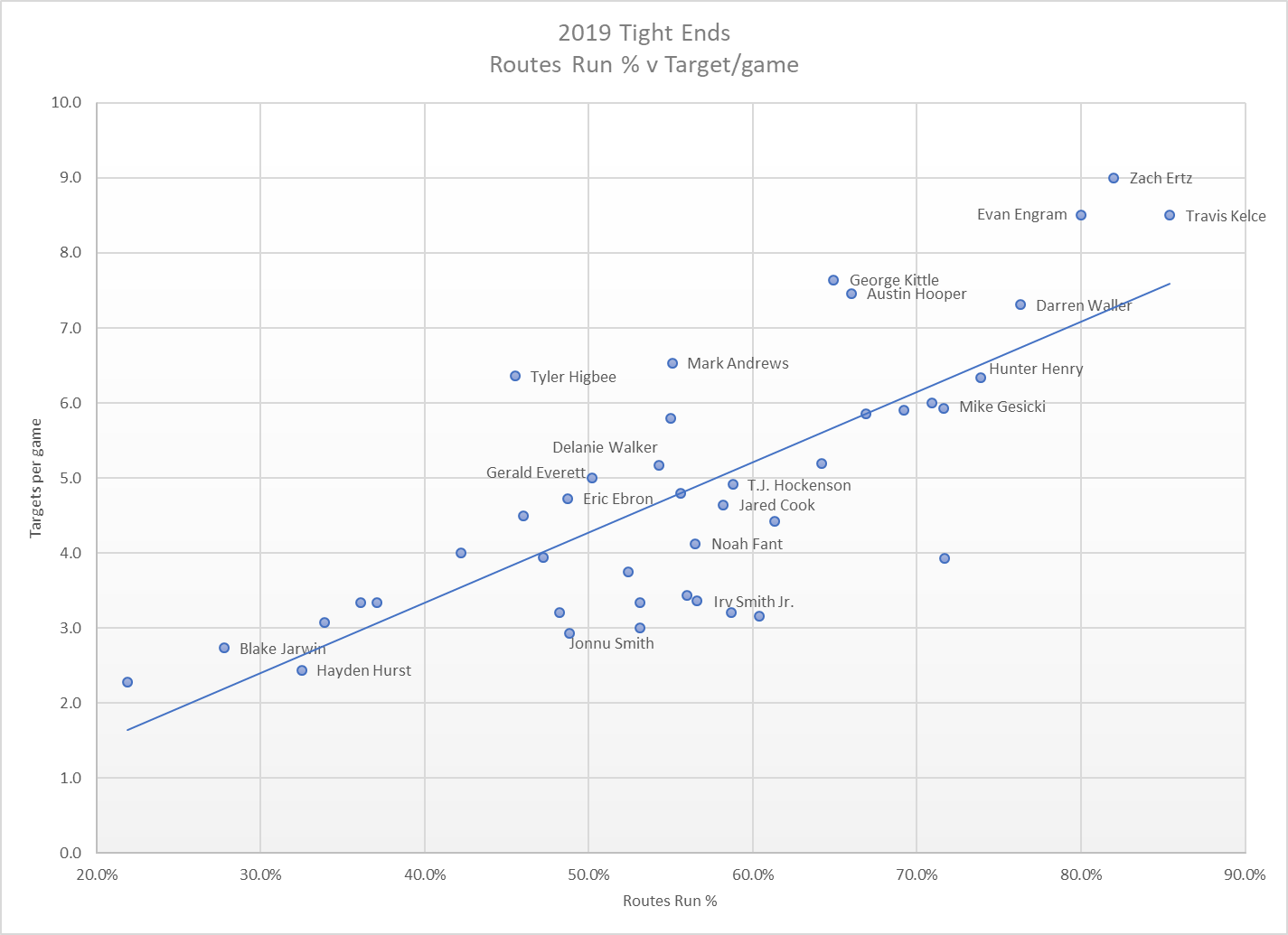
Firstly, I looked at the impact of routes run on the number of targets the Tight End gets:
See Where Mark Andrews Lands In Our 2020 Fantasy Rankings!
This is logical. The more the Tight End runs routes, the more targets they get. Andrews ran routes 98-percent of the time and Hurst ran routes 97-percent of the time. So we shouldn’t expect much impact here. What you can see here is that Hurst is significantly lower than Andrews but that’s just based on Hurst’s playing time being much lower. You might also notice that Andrews’ targets per game are higher than expectation. When you look who else sits high above the line, he’s in pretty good company with those elite and top end options.
Next, I looked at what impact the slot percentage had on average depth of target (aDOT).
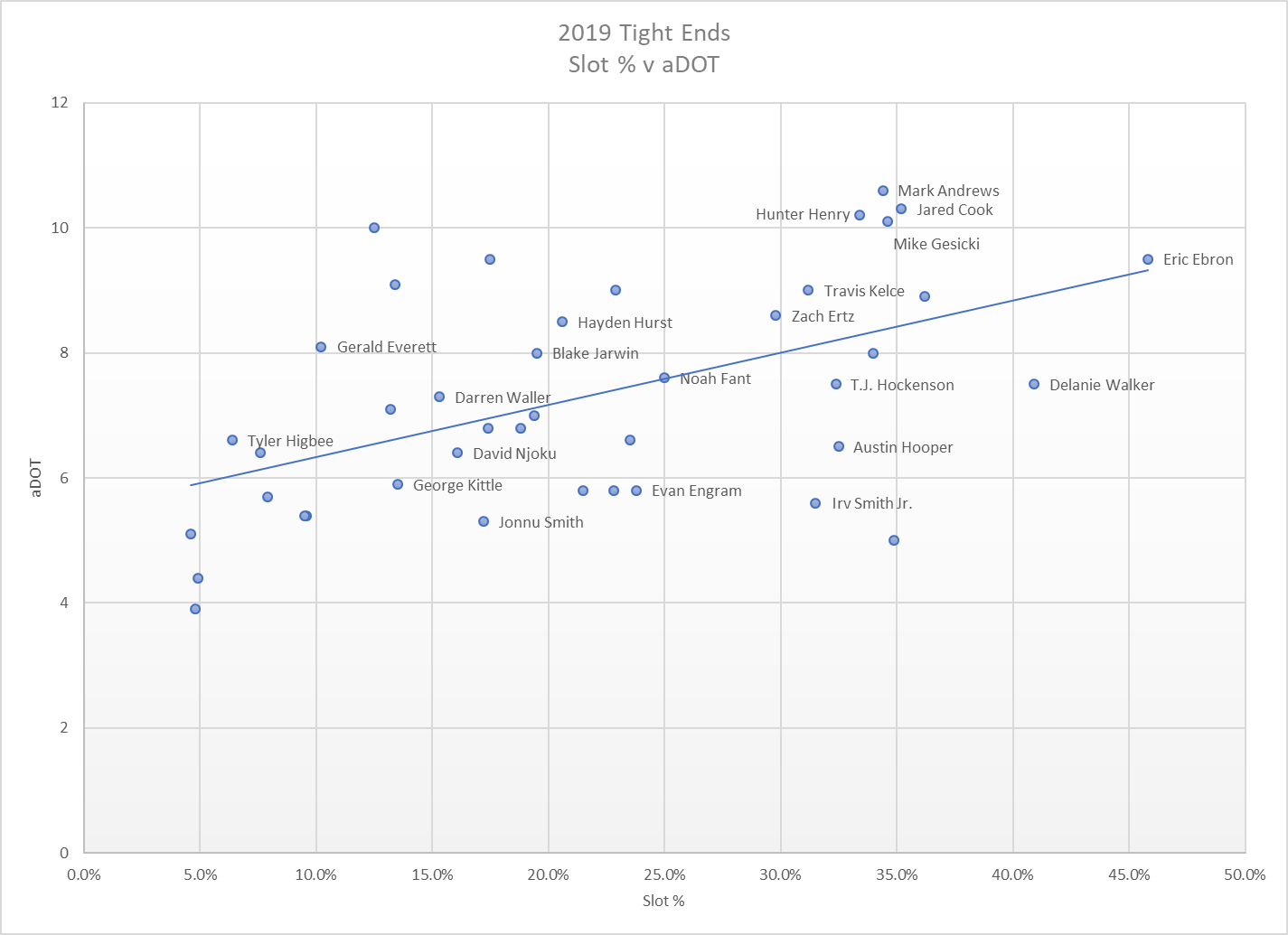
You can see that this graph is a little less correlated and erratic but generally speaking, the more the Tight End runs out of the slot, the deeper his average target. Again you’ll see that Andrews’ aDOT was significantly above expectation based on the amount he was in the slot. Incidentally, it’s the same story for Hurst.
Related | Tight Ends We Love To Draft In 2020
Let’s take my theory now on Andrews running from the slot less. If you bring him back down to the level of Hurst from 2019, and assume that he continues to get a depth of target above expectation, his aDOT could come down nearly two yards per target.
On his 2019 volume, that would be a 1.3 points-per-game difference. Everything else being equal, that would have brought him down to around TE8 in points-per-game. Add in that touchdown regression we discussed earlier and he’d be TE12.
CONCLUSION
Now I actually like Andrews and there’s other things working in his favor. The Ravens had the lowest pass volume in the league last year and that’s likely to increase. That means an increase in overall targets and even with the same market share. That means an increase in targets for Andrews.
He’s also still a red zone threat and will still catch plenty of touchdowns. And, theoretically, a decrease in aDOT usually means an increase in Yards After Catch (YAC), so it’s unfair to correlate a potential reduction in aDOT to be an exact decrease in yards.
I actually have Andrews projected as TE3 behind Kittle and Kelce but I have a little more caution and I wouldn’t be surprised if we see less from Andrews in the passing game as a result of the role he now needs to play in the run game.
Andrews is going to be one to watch with interest this year but if I’ve convinced you of nothing else, I hope that you now realize Hurst’s departure isn’t necessarily a good thing for Mark Andrews fantasy production in 2020.